Battle of the Blackwater
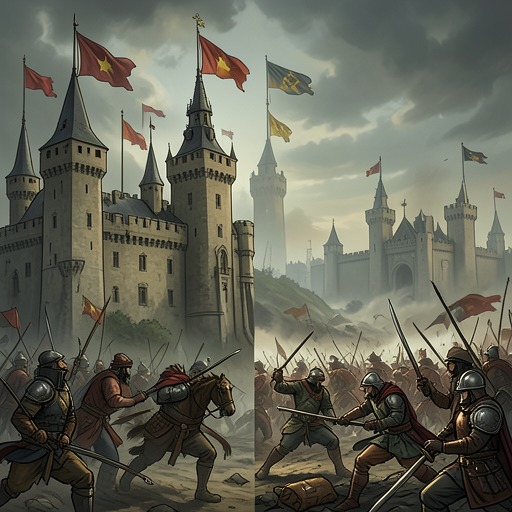
A Clash of KingsThe Battle of the Blackwater is the climactic defense of King’s Landing against Stannis Baratheon’s invasion, a battle whose decisive weapon is not simply courage or numbers but the coordinated use of river geography, naval engineering, incendiary weapons, fortified walls, and reinforcements. Stannis’s fleet initially appears strong enough to overwhelm the defenders, yet its advance ends in catastrophic destruction when wildfire traps the ships against the Chain boom across the Blackwater. The battle breaks Stannis’s host, saves the city, and redirects the War of the Five Kings by binding the survival of House Lannister to the power of Highgarden and Casterly Rock.
Causes and Strategic Setting
Stannis’s attack follows his claim to the Iron Throne and his attempt to seize King’s Landing before the city can recover from the conflicts surrounding the succession. His fleet gathers in force near Dragonstone. The port is crowded with war galleys, fishing vessels, carracks, cogs, and the Lysene ships of Salladhor Saan; Stannis’s flagship Fury lies among the largest vessels, alongside Lord Velaryon’s Pride of Driftmark and her sisters, Lord Celtigar’s Red Claw, and the heavy Swordfish. This concentration makes the assault look overwhelming, but it also exposes the invasion to the difficulties of moving a large fleet through hostile waters.
The fleet has already paid a price for its passage from Storm’s End. Two cogs are lost to the rocks of Shipbreaker Bay, a Myrish galley founders in the Straits of Tarth, and a storm scatters the ships as they enter the Gullet. Only twelve ships fail to regroup behind Massey’s Hook, yet the delays matter. Stannis’s mounted army, nearly twenty thousand knights, light horse, and freeriders, has traveled by land and waits on the south bank of the Blackwater Rush. Its horses, armor, and long lances are formidable on open ground but of little use against deep water and the high walls of King’s Landing.
Ser Imry Florent organizes the fleet into ten lines of battle, each containing twenty ships. The first two lines are intended to destroy Joffrey Baratheon’s smaller fleet, dismissively called the boy’s toys; succeeding lines are to land archers and spearmen beneath the city walls, while slower vessels ferry the main army across the river. Salladhor Saan’s Lysene galleys remain in the bay to guard against a concealed enemy force attacking the rear. The plan depends on speed and mass, but it rejects the caution Davos Seaworth considers necessary. Davos would have sent swift ships upriver to scout, whereas Ser Imry’s numerical advantage encourages a direct assault.
The Naval Engagement
Black Betha enters rough Blackwater Bay with Wraith and Lady Marya close beside her. Davos orders the sails lowered and the oarsmen to work because the fleet is to enter the river under oars, reducing the danger from the scorpions and spitfires mounted on the walls of King’s Landing. As the ships approach, Davos recognizes the defensive towers at the river’s mouth and notices that the southern tower is protected by a cut through the bank. Then sunlight flashes from steel beneath the dark water: the defenders have installed a chain boom across the river, though it has not yet been raised.
The enemy fleet forms a thin line across the river. Stannis’s ships press forward, and the battle quickly becomes a contest of rams, oars, grappling lines, and close fighting. Black Betha and Lady Marya strike Lady’s Shame from opposite sides with enough force to throw men from a neighboring galley. When Davos orders his ship to back water, the damaged vessel fills through its splintered hull and breaks apart, sending soldiers into the river. The scene reveals the material brutality of naval warfare: men in mail and plate sink beside the living, while the current carries both together.
The battle’s great reversal comes when green fire rises from the stern of Queen Alysanne. Wildfire burns with a force ordinary pitch cannot match, spreading across the water and consuming ships and men. The flames leap from vessel to vessel while the walls of King’s Landing add their own violence through spitfires and trebuchets. A stone as large as an ox crashes between Black Betha and Wraith, and Bold Laughter is destroyed by another boulder. The river becomes a battlefield in which fire, stone, tide, and crowded hulls combine against the attackers.
The collapse of Swordfish makes the danger still clearer. When the galley smashes into the rotted hulk, green liquid pours from broken jars and spreads across the river. Davos tries to pull Black Betha away, but the explosion throws him into the water. He survives by breaking the surface and clinging to debris, only to be turned by the current toward the raised chain. The Chain boom across the Blackwater stretches taut above the water, catching galley after galley. A dozen ships have already crashed into it; most are burning, and the remaining vessels are pressed into the same obstruction. Beyond the blazing wreckage lie Salladhor Saan’s ships, but the chain, red-hot steel, burning timber, and swirling green flame form an impassable barrier.
The Fighting at the Riverfront
The wrecks create an accidental bridge. From the walls, Tyrion Lannister sees Stannis Baratheon’s soldiers climbing from a broken galley that has struck a pier. Around twenty galleys are jammed together, their oars crossed, their hulls locked by grappling lines, and their rams driven into one another. Although many are wrecked, they are packed closely enough for soldiers to leap from deck to deck and cross the Blackwater. The same destruction that ruins Stannis’s fleet briefly gives his boldest men a path toward the city.
Tyrion responds with admiration and alarm. Stannis’s soldiers cross the unstable wreckage despite sinking decks, blood, and green fire. Tyrion leads his own men and Ser Balon Swann’s force along the quay, charging through smoke and ash. The attack drives the invaders back toward the water, though the fighting remains chaotic: a Celtigar spearman kills Ser Balon’s horse, and Tyrion must continue forward through the collapsing bridge of ships. The defenders’ success is therefore not effortless. It is won amid broken formations, burning vessels, and the constant possibility that the battlefield itself will give way.
Reinforcement and Victory
By dawn, bells ring from the Red Keep and the Great Sept of Baelor, and the sound is understood as a joyful celebration rather than a funeral knell. Ser Dontos tells Sansa Stark that the city has been saved, Stannis is dead or fled, and his host has been slaughtered, scattered, or forced to submit. His account is based on reports passed through Osney Kettleblack, Ser Osmund, Ser Balon’s men, and the gold cloaks, so it reaches Sansa as excited battlefield news rather than as a complete, verified record.
The decisive change in the battle comes from the arrival of Tywin Lannister with the forces of Highgarden and Casterly Rock. Their banners include the golden rose and golden lion, the Marbrand tree, the Rowan, Tarly’s huntsman, Redwyne’s grapes, and Lady Oakheart’s leaf. Tywin commands the right wing north of the river, Randyll Tarly the center, and Mace Tyrell the left, while the vanguard drives into Stannis’s forces. The relief army attacks through fields Stannis’s men have burned, its armor turned grey by ash, and breaks the besieging host at the moment when the fleet and riverfront assault have already been thrown into confusion.
Ser Dontos describes the vanguard as being led by Renly Baratheon in green armor, with golden antlers shining through the fire, and claims that Renly killed Ser Guyard Morrigen and other great knights. The report is false or impossible in its literal form, since Renly Baratheon is already dead, but it captures the political and emotional force of his memory: Stannis’s own men are said to bend the knee and shout for Renly. The rumor turns victory into spectacle and suggests that the defeated king is haunted by the brother whose claim he destroyed.
Consequences and Significance
The Battle of the Blackwater preserves Joffrey Baratheon’s immediate hold on King’s Landing and prevents Stannis Baratheon from taking the capital. Its outcome depends on the interaction of forces that no single commander fully controls: Ser Imry’s overconfident fleet formation, the hidden river chain, the alchemists’ Wildfire, the city’s artillery, Tyrion’s counterattack, and the late arrival of Tywin Lannister and the Tyrell army. The battle is therefore both a military victory and a demonstration of coalition warfare, in which dynastic survival rests on logistics, timing, and alliances as much as on the valor celebrated by songs.
The victory also alters the political balance of the War of the Five Kings. House Lannister survives not through isolated strength but through its alliance with House Tyrell, while Stannis loses the initiative that his superior fleet and large host seemed to guarantee. The river, initially a route into the city, becomes a trap; the fleet, assembled as an instrument of conquest, becomes the fuel and structure of its own destruction. In this reversal, the Battle of the Blackwater turns the material landscape of King’s Landing into the agent of political change.